
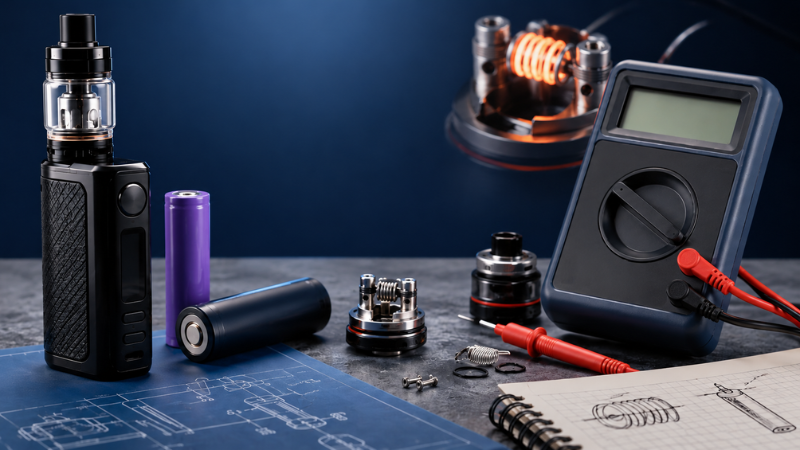
For many vaping enthusiasts, terms like voltage, resistance, wattage, and amps can seem a bit scary. However, as soon as you learn the basics of Ohm’s Law, understanding these concepts becomes much easier.
This simple principle helps explain how power moves through a vape device and how different components work with each other.
It also lays down the amount of amperage and wattage that your build will output, ultimately determining if your build’s resistance lies within safe limits for your battery.
Ignorance of these limits can lead to the explosion of batteries, making it crucial to understand battery safety before trying to build your own coil.
In this guide, we’ll take you through the key formulas, explain what they mean practically, and show how they lead to a safer vaping experience.
Whether you use a pod system, a regulated mod, or want to build a coil, learning Ohm’s Law will significantly improve your understanding of vaping electrical safety.
What is Ohm’s Law?
Ohm’s Law is a fundamental electrical formula that explains the relationship between voltage, current, and resistance in an electrical circuit. It is commonly employed in electronics, engineering, and vaping to understand how electricity works and behaves.
The formula:
Where:
- V = Voltage (Volts)
- I = Current (Amps)
- R = Resistance (Ohms)
In vaping, these variables work together when a device powers a coil. Voltage provides the electrical force, resistance determines how much the coil resists that force, and current measures the flow of electricity through the circuit.
Understanding this relationship helps users estimate amp draw, evaluate coil setups, and make better and more informed decisions regarding battery safety.
Why Ohm’s Law Matters for Safe Vaping
Ohm’s Law plays a crucial role in safe vaping as it helps users understand the electrical demands placed on batteries and coils.
Every vape setup needs a specific amount of current to operate, and pushing a battery’s capabilities can cause catastrophic battery failure, thermal runaway, or even explosion.
Understanding vaping voltage and resistance and current calculations can also help users appreciate how different coil builds affect battery performance. Lower resistance coils usually require more current, whereas higher resistance coils require less.
For users interested in rebuildable atomizers or mechanical mod safety, Ohm’s Law becomes even more important as there are fewer automated protections involved.
Even users of regulated vape devices benefit from understanding the basics, as it clarifies wattage settings, resistance readings, and battery behaviour.
In simpler words, Ohm’s Law is about understanding the relationship between power and safety, not just calculations.
How to Calculate Current Using Ohm’s Law
Formula for Calculating Current
Current, measured in amps, represents the flow of electrical energy through a circuit. In vaping, vape battery amp draw is a crucial factor because batteries are designed to deliver only a certain amount of current safely.
Formula for Calculating Current
I = V ÷ R
For example:
- Voltage = 4.2V
- Resistance = 0.5Ω
Current = 4.2 ÷ 0.5
Current = 8.4A
This means the battery would need to provide about 8.4 amps to power the coil in those conditions.
Understanding current calculations lets users estimate battery demands and understand how resistance changes can affect amp draw.
How to Calculate Voltage Using Ohm’s Law
Formula for Calculating Voltage
Voltage represents the electrical pressure that pushes current through a circuit. While a lot of vape users focus on wattage, voltage stays a crucial part of understanding the performance of the device.
Formula for Calculating Voltage
V = I × R
For example:
- Current = 10A
- Resistance = 0.5Ω
Voltage = 10 × 0.5
Voltage = 5V
This calculation shows how voltage changes according to the current and resistance levels. Many regulated devices take care of voltage output automatically, but having an understanding of the concept provides useful insight into device operation.
How to Calculate Resistance Using Ohm’s Law
Formula for Calculating Resistance
Resistance refers to how much a coil restricts the electrical flow. Coil resistance directly affects how much current is required from the battery.
Formula for Calculating Resistance
R = V ÷ I
For example:
- Voltage = 4.2V
- Current = 14A
Resistance = 4.2 ÷ 14
Resistance = 0.3Ω
Resistance calculations can also help users understand how different coil builds affect electrical demands and overall performance.
How Wattage Relates to Ohm’s Law
Understanding Power in Vaping
Wattage measures the amount of power delivered to the coil. It mainly determines how much heat the coil generates and therefore affects vapor production and flavor intensity.
Although wattage is usually discussed separately, it is connected closely to Ohm’s Law as voltage, current, and resistance all influence power output.
Common Power Formula
Power (W) = Voltage × Current
For example:
- Voltage = 4.2V
- Current = 10A
Power = 42W
Another commonly used formula is:
Power = V² ÷ R
This equation demonstrates why lower resistance coils can produce higher wattage when given the same voltage.
Understanding vaping resistance calculation lets users understand better how power settings affect coil performance, battery demand, and overall vaping experience.
Understanding the Key Components of Ohm’s Law
Ohm’s Law uses 3 main elements for calculations: voltage, current, and resistance. These are usually depicted in a triangle with V, I, and R. If you are familiar with two of the three, you can easily find out the third:
Voltage (V)
Voltage can be considered as the force that makes electricity flow through a circuit. When fully charged, a single battery will have 4.2V, whereas when the battery is discharged, the voltage will drop.
In vaping, voltage impacts how much power reaches the coil. Higher voltage typically increases power output, assuming resistance remains the same.
Current (Amps)
Current measures the electricity’s flow. It’s a crucial safety consideration as batteries have maximum continuous discharge ratings. Using the hose analogy, if voltage is water pressure, then amperage is the actual amount of water (current) flowing through the hose.
Resistance (Ohms)
Resistance is determined mainly by the coil. Different designs, materials, and configurations produce different values. A lower resistance coil will draw higher amperage from your battery and vice-versa.
This makes calculating resistance essential for coil building safety within the safe vape battery amp limits of your battery.
So together, voltage, current, and resistance serve as the foundation of Ohm’s Law and explain how vape devices generate heat and vapor.
Practical Vape Safety Tips
Here are some practical vape safety tips:
Use Authentic Batteries
Always use genuine batteries from reputable manufacturers, as counterfeit ones may not perform according to expectations and can even pose unnecessary risks. Also, opt for accessories from trusted sources as they comply with safety standards.
Check Coil Resistance Regularly
Resistance can change over time due to coil wear, installation issues, or damage. So monitoring it helps ensure the setup continues as expected.
Avoid Damaged Battery Wraps
Battery wraps provide insulation and protection, so if they get torn or damaged, replace or repair them immediately.
Use Trusted Chargers
Charging equipment plays a crucial role in battery health, so always use high-quality charging accessories to support safe charging practices and stable battery performance.
Never Exceed Vape Battery Ratings
Every battery has some limitations, so understanding them and staying within its specifications is one of the most important aspects of vaping battery safety.
Use Devices With Overcharge Prevention
Use devices that have overcharge prevention along with temperature control and short-circuit safeguards.
Regularly Clean and Replace coil
Clean and replace the coil regularly to prevent the buildup of residue. And if you think that it’s burnt out, get rid of it instead of risking a bad experience.
Frequently Asked Questions
Do regulated vape mods use Ohm’s Law?
Yes, regulated vape mods use the same electrical principles described by Ohm’s Law at a physics level. The difference is that built-in built-in chipstes perform many calculations automatically and adjust power delivery without needing manual calculations from the user.
How do I calculate amps for vaping?
To calculate amps for vaping, divide voltage by resistance using the formula I = V ÷ R for regulated mods to determine the continuous current drawn from your batteries.
What is a safe coil resistance for vaping?
There is no universal coil resistance value that is completely safe. Safe resistance depends on the device, battery’s specifications, intended wattage range, and manufacturer recommendations. So always check your device’s range for the safest performance.
Do beginners need to learn Ohm’s Law?
Yes, beginners need to learn Ohm’s Law as it is the absolute foundation of electronics that lets you determine what resistor to use for an LED, find out power draw, and troubleshoot circuits without affecting components.
It also helps users understand device operation, battery behavior, and other important vaping safety concepts.
Can Ohm’s Law help prevent battery accidents?
Yes, Ohm’s Law can help prevent battery accidents by letting users estimate current draw, understand battery demands, and figure out the relationship between resistance and power. This knowledge can support safer decision-making when choosing batteries, coils, and device settings.
Final Thoughts
Ohm’s Law is one of the most crucial concepts for understanding how vape devices operate safely. By learning the relationship between voltage, current, resistance, and wattage, you can gain a clearer understanding of battery demands and device performance.
Whether you are adjusting wattage settings, monitoring vape coil resistance, or learning about battery safety, Ohm’s Law provides the foundation for making informed decisions.
Lastly, always make sure that you practice battery safety and stay within the limits of your battery amperage rating.