
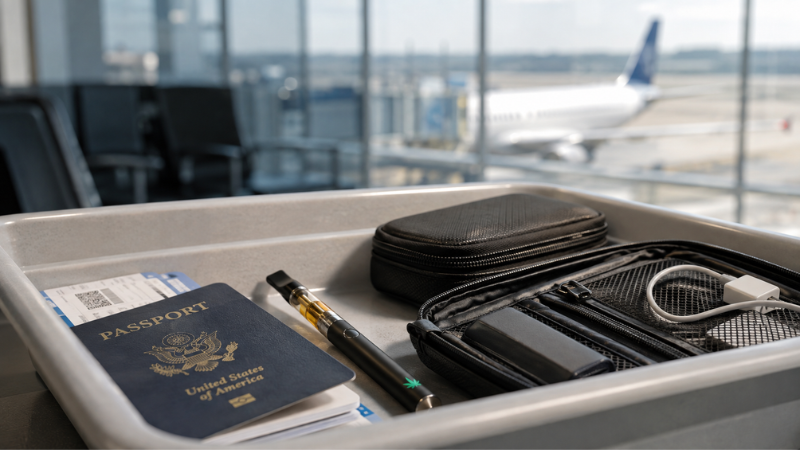
If you want to fly with a THC vape, you have landed at the perfect place. The reason we are saying this is that traveling with a THC vape is more than just throwing your device in your backpack.
Federal cannabis laws, TSA (Transportation Security Administration) procedures, FAA (Federal Aviation Administration) battery regulations, airline policies, and the laws at both your departure and destination all play a crucial role in deciding what may happen during your journey.
The confusion usually comes from the fact that cannabis laws vary significantly across the U.S. While several states allow medical or recreational marijuana, THC remains illegal under U.S federal law, and air travel is regulated at the federal level.
At the same time, TSA’s main mission is transportation security, not enforcing drug laws, while the FAA has separate rules governing how vape devices and lithium batteries must be packed.
In this guide, we’ll take you through what existing TSA and FAA rules say, how federal and state cannabis laws work, and what travelers should know before bringing a THC vape on an international or domestic flight.
Can You Bring a THC Vape on a Plane?
The short answer is it depends, but travelers should stay cautious. Whether you can bring a THC vape on plane depends on many factors, including federal law, THC vape TSA guidelines, airline policies, the laws where your trip starts and ends, and whether you are flying internationally or domestically.
Although a lot of U.S. states have legalized medical or recreational cannabis, THC stays illegal under U.S. federal law in many situations, and airports work under federal jurisdiction.
At the same time, the TSA’s primary job is transportation security instead of actively looking for cannabis products. If TSA officers find a potentially prohibited substance during the screening process, they may refer the case to local law enforcement.
Travelers should also keep in mind that the FAA typically requires vape devices containing lithium batteries to be packed in carry-on baggage rather than checked luggage.
Plus, airline policies, local cannabis regulations, and the laws at your destination may all affect whether traveling with a THC vape is allowed or advisable.
Is It Legal to Fly With a THC Vape?
The legality of flying with a THC vape is not as simple as many travelers think. While many U.S. states have legalized medical or recreational cannabis, THC remains illegal under U.S. federal law in many circumstances, and commercial air travel operates under federal jurisdiction.
Consequently, state legalization doesn’t by default mean that bringing a THC vape onto a place is legally permitted.
Federal Law vs. State Cannabis Laws
One of the biggest sources of confusion is the difference between state and federal cannabis laws.
A lot of states allow adults to buy and keep cannabis products legally within state boundaries, but federal law continues to categorize marijuana as a controlled substance in many circumstances.
As airports, TSA security checkpoints, and commercial aircraft work under federal authority, complying with state cannabis laws doesn’t necessarily eliminate potential legal issues when traveling by air.
Domestic Flights vs. International Flights
Domestic travel and international travel involve different levels of legal risk. On domestic flights, the consequence may depend on factors such as the airport, local law enforcement policies, and the cannabis laws in your departure and destination states.
International travel usually carries considerably greater legal risk as travelers must also align with customs laws and the cannabis regulations of the other country.
Some countries impose hefty penalties for cannabis possession, regardless of where the product was bought legally.
For that reason, travelers should practice extra caution and review applicable laws thoroughly before planning international travel with any THC product.
What Does TSA Say About THC Vapes?
The TSA (Transportation Security Administration) is responsible for safeguarding the country’s transportation systems by screening baggage and passengers for security threats.
Its main job is aviation security, not actively searching for marijuana or other controlled substances.
However, because airport security operates under federal authority, the discovery of a THC vape during screening may still have legal problems depending on the circumstances.
TSA’s Primary Focus
TSA officers are trained to identify items that may cause danger to aviation, such as explosives, weapons, and other banned articles. They do not actively search travelers specifically for cannabis products.
However, if a THC vape or another potentially banned substance is discovered during the routine security screening procedure, TSA officers may take extra steps in alignment with federal procedures.
If a TSA officer comes across a suspicious THC vape during passenger inspection or baggage screening, the item is not ignored.
Instead, the officer may inform the concerned law enforcement agency to determine how the situation should be taken care of. TSA itself doesn’t decide whether a passenger has violated local cannabis laws.
When TSA May Involve Law Enforcement
What happens next can vary depending on the airport and local jurisdiction. In some places, law enforcement may determine that no further action is required, while in others, the traveler could face extra screening, interrogation, confiscation of the product, citations, or other legal issues.
Because enforcement practices vary between jurisdictions, travelers should never assume that the same outcome will apply at every airport.
FAA Rules for Traveling With Vape Devices
The Federal Aviation Administration (FAA) regulates the safe transport of electronic smoking devices on commercial planes.
Regardless of whether a vape contains nicotine, CBD, or THC, the FAA’s battery safety requirements typically apply as these devices are powered by lithium-ion batteries. These rules are aimed at reducing the risk of battery fires and other in-flight safety dangers.
Carry-On vs. Checked Baggage
Electronic smoking devices, including disposable vapes, vape pens, and spare lithium batteries, should usually be packed in your carry-on baggage instead of checked luggage.
Lithium-ion batteries can pose a fire risk if damaged or exposed to certain conditions, making it crucial for any battery-related accident to be detected and avoided quickly inside the plane’s cabin.
Passengers should also take appropriate steps to avoid accidental activation during transport.
Depending on the device, this may include switching it off, using a protective case, engaging a lock mechanism, or following other measures suggested by the manufacturer.
If your carry-on bag must be gate-checked, remove your vape device before giving the bag to airline staff.
Disposable vs. Rechargeable THC Vapes
Both rechargeable and disposable THC vapes are subject to the same general FAA battery safety requirements, as they are equipped with lithium-ion batteries.
However, rechargeable devices may include removable batteries or charging accessories that should also be transported according to airline and FAA guidance.
Plus, passengers should not charge or use vape devices while onboard the aircraft and should review their airline’s policies before traveling, as certain carriers may impose some additional restrictions.
Can You Put a THC Vape in Checked Luggage?
In most scenarios, no. If a THC vape is equipped with a lithium-ion battery, which includes most rechargeable and disposable vape devices, it should usually not be packed in checked baggage.
FAA safety guidance needs electronic smoking devices with lithium batteries to be sent in carry-on baggage, as battery-related accidents are easier to detect and take care of inside the aircraft cabin than in the cargo hold.
Why It’s Generally Not Allowed
Lithium-ion batteries can overheat or become worn out if they are exposed to certain conditions during shipment. Although battery accidents are rare, they can still pose a fire risk.
Because of this, aviation and airline authorities typically need travelers to keep vape devices with them in the cabin instead of in the checked luggage.
If your carry-on bag is gate-checked before boarding, you should remove your vape and carry it with you whenever possible.
Risks Associated With Checked Baggage
Keeping a THC vape in checked luggage may result in your bag being flagged for extra inspection if security officers identify a banned electronic smoking device or lithium battery during baggage screening.
Depending on the situation, airport staff may remove the device, delay your baggage, or go through additional screening before the bag is given a green signal for transport.
It’s also crucial to keep in mind that complying with FAA battery requirements doesn’t determine whether a THC vape is permitted under federal, state, or local cannabis laws.
Battery safety regulations and cannabis laws are separate issues, and travellers should understand both before flying.
What Happens If TSA Finds a THC Vape?
If a TSA officer finds a THC vape during security screening, the outcome can differ depending on the situation and airport where you’re traveling.
TSA’s main job is transportation security instead of imposing drug laws, but officers may take some extra steps if they come across a potentially banned substance during routine screening.
Possible Outcomes
If a THC vape is discovered during baggage screening or a passenger inspection, TSA may carry out additional screening to better know what has been found.
If the item is believed to contain a substance that could violate laws, TSA officers may inform the appropriate local law enforcement agency. Then, the local authorities will take it forward from there.
Possible outcomes differ by jurisdiction and may include letting the traveler get rid of the product, confiscation, interrogation by law enforcement, issuance of a citation, or other actions permitted under local laws.
More serious outcomes may be possible in circumstances involving larger quantities, suspected criminal activity, or other escalating circumstances.
Does Airport Location Matter?
Yes. Airport location can significantly impact how a situation is managed, as local law enforcement agencies follow the laws and policies of their jurisdiction.
At airports located in states where cannabis is legal, officers may exercise discretion depending on the situation and local regulations. In states where cannabis remains prohibited, travelers could face harsher enforcement actions.
Because airport procedures and local laws are different, travelers shouldn’t assume that the same outcome will apply everywhere else.
Flying Within the U.S. vs. Flying Internationally
The legal considerations for traveling with a THC vape can vary significantly depending on whether you’re taking a domestic flight within the U.S or crossing an international border.
While both types of travel involve aviation security and transportation regulations, international travel typically carries much greater legal risk as multiple countries’ laws may apply.
Domestic Travel Considerations
For domestic flights, travelers should keep in mind that cannabis laws differ from state to state, while commercial air travel stays subject to federal regulations.
Even if both your destination and departure states have legalized medical or recreational cannabis, that does not by default mean traveling with a THC vape is permitted legally.
Plus, connecting flights can introduce undesirable legal issues if your itinerary includes airports in states with different cannabis laws or enforcement practices.
Before traveling, review the regulations that are applicable at your departure airport, any transit locations, and your final destination.
International Travel Risks
International travel needs even more caution. In addition to US regulations, passengers must comply with the cannabis and customs laws of every country they go to or transit through.
Several countries have far harsher cannabis laws than certain US states, and possession of THC products may lead to confiscation, denial of entry, hefty fines, arrest, or other legal outcomes.
Because customs authorities may check travellers and baggage when crossing international borders, anyone thinking about international travel should research the laws of their destination carefully and any connecting countries before arriving with a THC vape or any other cannabis product.
Medical Cannabis Patients: Are the Rules Different?
Medical cannabis patients may have some extra protections under certain state laws, but those protections don’t apply to air travel automatically.
Although several states allow qualified patients to keep and consume medical marijuana with a valid medical cannabis card, commercial aviation is regulated under federal law, making the legal scenario more complicated.
A valid medical marijuana card may be recognized within the state that issued it, but it doesn’t guarantee that carrying a THC vape through an airport or onto an aircraft is permitted legally.
TSA offices focus mainly on transportation security, and if a potentially banned substance is found during screening, the matter may still be reported to local law enforcement for further evaluation.
Medical cannabis patients should also keep in mind that FAA safety requirements for vapes continue to apply regardless of the reason for using the product.
Additionally, medical marijuana reciprocity and possession laws differ from state to state, meaning a medical cannabis card issued in one state may not be valid in another.
Before traveling, patients should review the laws at both their departure and destination, consult their airline’s policies, and carry any applicable documentation if needed.
Tips Before Traveling With a THC Vape
If you are planning to travel with a THC vape, taking some precautions can help you understand the relevant rules and decrease the risk of undesirable issues during your travel.
Check State and Local Laws
Cannabis laws differ across the US. Before traveling, review the regulations that apply in your departure state, transit locations, and your destination. State legalization doesn’t override federal aviation regulations automatically.
Review Airline Policies
In addition to FAA and TSA weed vape rules, airlines may have their own policies regarding lithium batteries and electronic smoking devices. Checking these policies before your departure can help you stay away from last-minute surprises.
Understand TSA and FAA Requirements
Know the difference between TSA’s security screening role and the FAA’s battery safety rules. Vape devices equipped with lithium batteries should be packed in carry-on baggage, and travelers should follow all airline safety guidelines.
Consider the Legal Risks
Before taking any THC product on a trip, ask yourself whether the potential legal issues are worth the decision. If you are not sure about the laws or airline policies, the safest option may be to avoid traveling with a THC vape at all.
Common Mistakes Travelers Make
Traveling with a THC vape is more than just throwing it in your bag. A lot of travelers by mistake create problems for themselves by misunderstanding TSA procedures, FAA safety rules, or the differences between state and federal cannabis laws.
Avoiding these common mistakes can help avoid needless complications during your journey.
Assuming State Laws Apply Everywhere
One of the biggest misconceptions is thinking that travelling between 2 states where cannabis is by default legal makes flying with a THC vape legal.
While state laws may allow cannabis possession, airports and commercial flights work under federal regulations, and local enforcement practices can differ.
Packing Vape Devices in Checked Baggage
Several travelers mistakenly place rechargeable or disposable vape devices in checked luggage. Because these devices contain lithium-ion batteries, FAA safety rules typically require them to be transported in carry-on baggage instead of the aircraft’s cargo hold.
Ignoring Airline and Airport Policies
Some travelers believe that TSA THC vape rules are the only rules they need to follow. But they aren’t aware of the fact that airlines may have some additional policies regarding vape devices, and airports in different jurisdictions may manage cannabis-related incidents in different ways.
Forgetting About Connecting Flights
Even if your departure and destination states have legalized cannabis, a connecting flight through another state or another country may expose you to different laws and policies. So always review the regulations for every stop on your way.
Traveling Internationally Without Research
One of the biggest risks is thinking cannabis laws are the same around the world. Many countries have far harsher rules than the US, and travelers may face serious consequences if they are found with prohibited THC products.
Frequently Asked Questions
Can TSA detect a THC vape?
TSA screening equipment can detect the presence of a vape device during baggage screening, but it doesn’t identify whether a cartridge contains THC or nicotine. If a potentially banned substance is found, TSA may inform the local law enforcement.
Will TSA confiscate my THC vape?
Not necessarily. If a THC vape is found during screening, TSA may refer the matter to local law enforcement. Depending on the airport and applicable laws, authorities may confiscate the product, request its disposal, or take other appropriate steps.
Can I carry a disposable THC vape on a plane?
Disposable vape devices containing lithium batteries usually belong in carry-on baggage under FAA safety rules. However, whether a THC vape itself is permitted depends on local regulations, federal law, airline policies, and your travel plans.
Can I fly with a THC cartridge?
Flying with a THC cartridge involves legal considerations beyond airline security. While TSA focuses on transportation security, travelers should understand that federal cannabis laws, state regulations, and destination-specific rules may all affect whether taking one with you is permitted.
Can I take a THC vape on an international flight?
International travel with a THC vape carries significantly more legal risk as travelers must comply with the cannabis laws and customs of every country they enter or transit through. So always research destination regulations before flying internationally.
What should I do if I’m unsure about local cannabis laws?
If you aren’t sure about cannabis laws, review official government guidance for your departure point, destination, and any connected locations. When the rules are not clear, avoiding travel with THC products is typically the safest and most cautious approach.
Final Thoughts
Flying with a THC vape is more complicated than many travelers think. It’s not just a question of whether cannabis is legal in your state.
Federal law, TSA screening procedures, FAA battery safety requirements, airline policies, and the laws at your destination all play a crucial role in determining what may happen during your travel.
Before traveling, take time to understand the regulations that apply to your departure point, any connecting locations, and your final destination.
Keep in mind that following FAA battery rules doesn’t automatically imply a THC vape is permitted legally under local or federal cannabis laws.
If you aren’t sure whether traveling with a THC vape is fine, the best approach is to review official government guidance, check your airline policies, and avoid making assumptions according to other travelers’ experiences.
Staying informed and following applicable laws and safety requirements can help you avoid undesirable problems and make your travel as smooth as possible.